

Issue 05 · 2024
Along the Atlantic coast
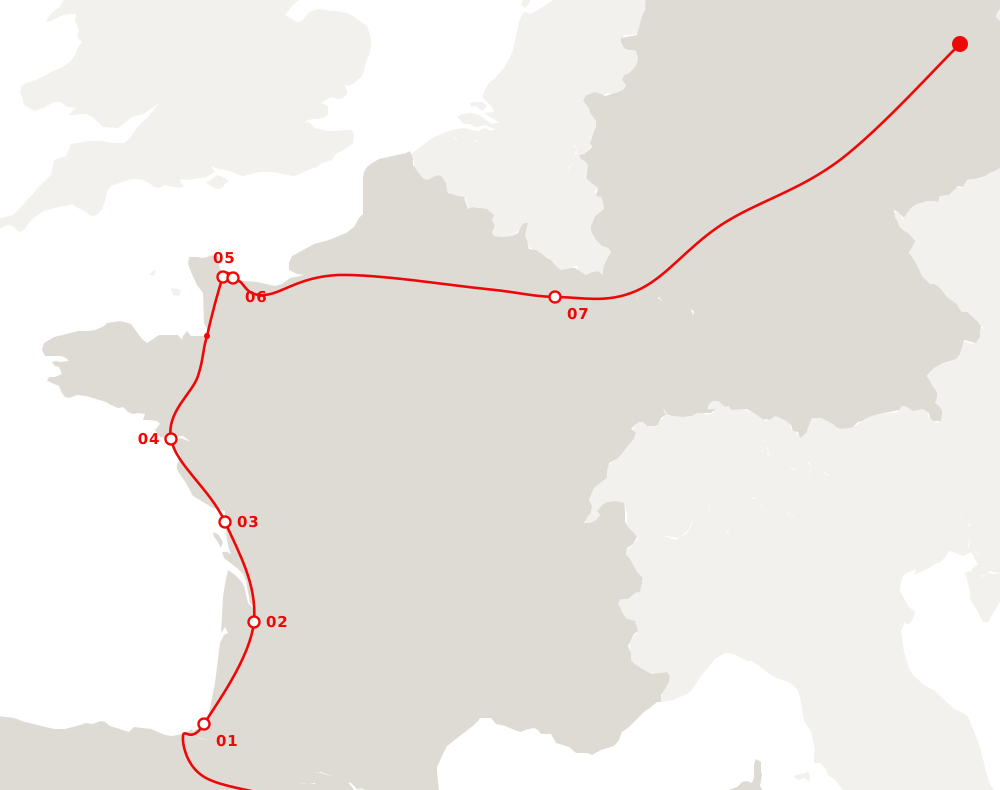
After some time in Spain, there were two possible routes back to Berlin to visit friends and festivals.
One went through the south of France, Italy and Austria, the other through France and Luxembourg.
Since I had never seen France’s Atlantic coast, I decided to drive along it.
The first stretch took me into the Pyrenees, which of course are partly in Spain – I’m simply counting them as part of the France chapter.
The trip in numbers
Year — 2024
Countries — Spain, France, Germany
Distance — approx. 2,650 km
Diesel — approx. 530 l · €800


Mont Saint-Michel
I can only recommend visiting Mont Saint-Michel in the evening. It looks beautiful and there are far fewer people around than during the day. The picture shows what it’s like in daytime ... at night I walked through the streets almost alone.


In oyster farming, young oyster larvae are raised in baskets on the “beach”. They grow on artificial structures such as racks, baskets or ropes hung in the water until they are big enough to be harvested and sold. They’re harvested at low tide, when you can walk – or drive a tractor – several hundred metres out into the sea.
Many people collect the oysters left over after the harvest in small buckets. I don’t like oysters, so I just watched.


On 6 June 1944, D-Day, the Allies landed at Pointe du Hoc. The US Army’s 2nd Ranger Battalion was ordered to scale the strategically important cliffs and destroy the German guns. Despite heavy fire and great losses, the Rangers reached the top – only to find that the guns had been moved. They eventually found and destroyed them further inland and held the position against German counter-attacks until reinforcements arrived. This operation contributed decisively to the success of the Normandy invasion.
You can still see today how the ground was ploughed up by the intense bombardment from the air and the sea.


Omaha Beach
Many of us know the infamous Omaha Beach ... most probably from the opening scene of the anti-war film “Saving Private Ryan” starring Tom Hanks. The real Omaha Beach looked somewhat different – not least because the bunker in the film, from which the Germans fire onto the beach, was actually an artillery observation bunker. The bunkers defending the beach looked less spectacular, but you have to give directors that freedom.
Some eyewitnesses do say, however, that the atmosphere on the beach was captured very well.
My trip took me past this stretch of beach, and I found it impressive to see this historic place.
The view from the bunker in the left picture is WN62 (resistance nest), where Hein Severloh, the “Beast of Omaha”, was stationed. There’s a very interesting documentary about this German soldier who shot between 1,000 and 2,000 Americans with his machine gun that day. He later met Americans who had landed on the beach and became friends with some of them. An interesting story that shows the madness of war ...
Unfortunately I can’t find the Spiegel TV documentary, but here is another video on the topic: YouTube


The Battle of Verdun, one of the longest and bloodiest of the First World War, lasted from February to December 1916. German troops attacked the heavily fortified French city of Verdun to wear down the French army. The French put up fierce resistance.
The fighting was marked by intense artillery fire and huge losses on both sides. Despite heavy casualties, the French managed to hold Verdun. In the end, the front lines barely moved, but the battle had greatly exhausted both armies and became a turning point in the war.


The massive bombardments not only left huge craters, they also tore the soldiers’ bodies apart. The explosions often destroyed bodies so completely that only single bones or small bone fragments remained. Many soldiers were literally blown to pieces.
The remains of 130,000 soldiers are kept in the Douaumont Ossuary. Even today, off the paths, you find bones, ammunition and shells everywhere, along with remains of tools, tins and more.
In the middle picture you can still see where the trenches ran.

Fort Vaux and Fort Douaumont played a central role in the Battle of Verdun. Fort Douaumont was captured by the Germans in February 1916 and was a strategic point that triggered heavy fighting. Fort Vaux fell in June 1916 after fierce resistance by French troops, yet became a symbol of the bravery and relentless fighting spirit of Verdun’s defenders.


